Achilles Test Platform

ATP evaluates how industrial devices and control systems handle malformed & unexpected network communications, helping identify protocol weaknesses & risks in critical systems.

HOW ATP WORKS

How the Achilles Test Platform Operates

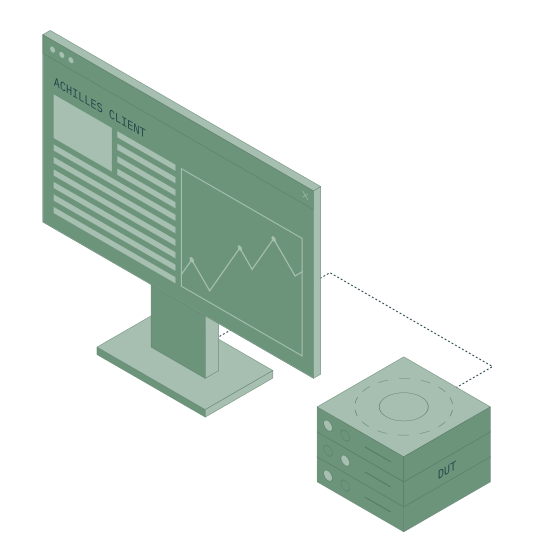
Achilles Test Platform sits inline between system communications and the device under test (DUT), introducing controlled test traffic while continuously monitoring behavior.

How ATP Works
ATP-4S

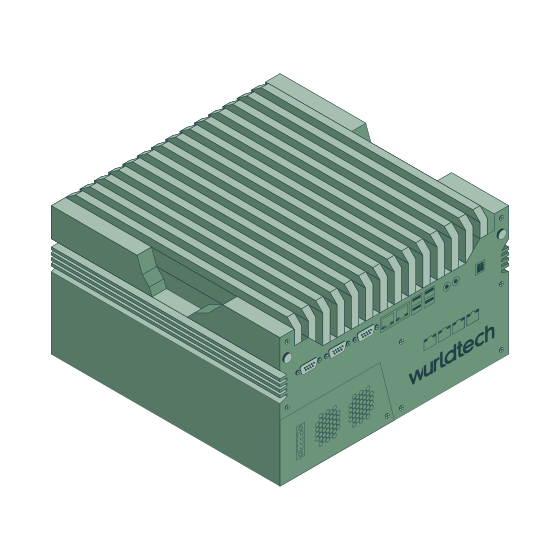
ATP-4S

The ATP-4S is a physical test appliance designed for controlled laboratory environments where consistent performance and repeatable results are critical.It evaluates how industrial devices handle abnormal and high-stress network conditions, providing deep visibility into protocol behavior, communication stability, and fault tolerance.

v-ATP-4S

v-ATP-4S delivers Achilles testing capabilities in a virtual, software-based environment without the need for dedicated hardware.It enables engineers to evaluate device behavior under abnormal network conditions, identify protocol handling issues, and validate robustness earlier in the development lifecycle.
v-ATP-4S

functionality

Core Capabilities of the Achilles Test Platform

Purpose-built capabilities that enable rigorous, repeatable cybersecurity and robustness testing for industrial control devices.

Automated & Repeatable Testing

Executes large test suites efficiently and consistently without manual intervention.

Real-World Network Simulation

Simulates real operational conditions, including malformed, excessive, and unexpected traffic.

Industrial Protocol Testing

Tests a wide range of industrial and IT protocols used in critical infrastructure environments.

Continuous Device Monitoring

Continuously tracks device behavior, performance, and stability across all test phases.

Detailed Reporting

Generates summaries and detailed reports to support analysis, remediation, and certification.

Scriptability via HTTP API

The Achilles HTTP API allows users to write scripts that can remotely manage and automate any function of the ATP-4S. It is not currently available on the v-ATP-4S.

ATP-4S v/s v-ATP-4S

Which Achilles Test Platform is Right for You?

Compare ATP-4S and v-ATP across deployment, performance, and testing workflows to support informed decision-making.

Feature

ATP-4S

v-ATP-4S

Supported Protocols

Supports a wide range of industrial and communication protocols & more are being added

Same protocol support as ATP-4S; No Inline Damage tests

Monitoring Capabilities

Includes all monitors

Limited monitoring (excludes Analog, Discrete, Link State, and Heartbeat monitors)

Type of Device Under Test (DUT)

Devices with redundant network interfaces for monitoring or damaging communications with VCS(Vendor control system)

Applications listening for network communications on any OS.

Devices with single network interface.

Applications listening for network communications on any OS.

ACC Certification

Eligible for Achilles Communication Certification (ACC)

Not eligible for ACC

API Access

HTTP API (REST API) available for automation and integration

Available for automation and integration into CI/CD workflows

coming soon...

Performance

Consistent, hardware-optimized performance

Performance depends on host machine configuration

Test Case Summary

Achilles delivers comprehensive protocol testing for industrial and IT networks. Each of our hundreds of test cases is built from hundreds or even thousands of sub-tests that rigorously probe protocols through fuzzing, malformed packets, stress scenarios, and edge-case conditions to uncover vulnerabilities before they disrupt operations.Flexible "user-defined" and "damage" tests let you test any protocol, while known vulnerability tests target critical CVEs to safeguard against known threats.

Protocol

Protocol Full Name

Description

Stack

Ethernet

Ethernet (IEEE 802.3)

Provides the foundational wired networking technology used to interconnect devices within local and wide area networks, enabling reliable data exchange across the core network layer.

INTERNET

ARP

Address Resolution Protocol

Enables systems to discover the hardware addresses associated with IP addresses, allowing devices to communicate effectively within local networks.

INTERNET

LLDP

Link Layer Discovery Protocol (IEEE 802.1AB)

Allows network devices to advertise identity and capability information, supporting topology discovery and simplified network management.

INTERNET

IP

Internet Protocol - IPv4

Handles logical addressing and routing of data packets across interconnected networks.

INTERNET

ICMP

Internet Control Message Protocol

Supports network diagnostics and error reporting, helping operators identify reachability issues and performance problems.

INTERNET

IGMP

Internet Group Management Protocol

Manages multicast group memberships, allowing efficient delivery of data streams to multiple subscribed receivers.

INTERNET

TCP

Transmission Control Protocol

Ensures reliable, ordered, and error-checked data delivery between applications, forming the backbone of most business-critical communications.

INTERNET

UDP

User Datagram Protocol

Enables fast, connectionless data transmission where low latency is prioritized over reliability, common in streaming and real-time services.

INTERNET

FTP

File Transfer Protocol

Supports the transfer of files between systems, often used in legacy integrations and controlled data exchange workflows.

IT

HTTP

Hypertext Transfer Protocol

Enables web-based communication between clients and servers, forming the foundation of modern application and service delivery.

IT

HTTPS

Hypertext Transfer Protocol Secure

Secures web communications through encryption, protecting data confidentiality and integrity for online services.

IT

NTP

Network Time Protocol

Synchronizes system clocks across networks, ensuring consistent timekeeping for logs, authentication, and transaction ordering.

IT

RDP

Remote Desktop Protocol

Allows remote access to desktop environments, supporting administration and remote workforce operations.

IT

RPC

Remote Procedure Call

Enables applications to execute functions on remote systems as if they were local, simplifying distributed system interactions.

IT

SNMP

Simple Network Management Protocol

Provides monitoring and management capabilities for network devices, supporting visibility, alerting, and performance tracking.

IT

Telnet

Teletype Network

Basic remote command-line access and is typically retained only in legacy environments due to security limitations.

IT

DNP3

Distributed Network Protocol version 3.0

Transmits telemetry and control commands securely and reliably in industrial environments.

CONTROL (ICS / OT)

EtherNet/IP-CIP

Industrial Protocol & Common Industrial Protocol

Real-time industrial automation communications, enabling control and monitoring of manufacturing systems.

CONTROL (ICS / OT)

Foundation Fieldbus HSE

Foundation Fieldbus High Speed Ethernet (IEC 61158)

High-speed industrial process control communications across distributed control systems.

CONTROL (ICS / OT)

GOOSE

Generic Object Oriented Substation Events (IEC 61850)

Enables fast event-driven messaging in electrical substations, supporting protection and control automation.

CONTROL (ICS / OT)

IEC 104

IEC 60870-5-104

Supports telecontrol communications between control centers and remote electrical equipment.

CONTROL (ICS / OT)

MMS

Manufacturing Message Specification (IEC 61850)

Facilitates structured data exchange between industrial devices and supervisory systems.

CONTROL (ICS / OT)

MODBUS/TCP

Modular Bus Transmission Control Protocol

Enables control and monitoring of industrial devices over standard IP networks.

CONTROL (ICS / OT)

MODBUS TLS

Modular Bus Transmission Layer Security

Encrypts and secures MODBUS/TCP communications

CONTROL (ICS / OT)

OPC UA (With Seccurity Option)

Open Platform Communications Unified Architecture

Enables secure, platform-independent interoperability between industrial systems and enterprise applications.

CONTROL (ICS / OT)

PROFINET

Process Field Net

Supports real-time Ethernet-based communication for industrial automation and motion control.

CONTROL (ICS / OT)

SES-92

Semantic Endpoint Security

Supports substation automation communications for monitoring and control functions.

CONTROL (ICS / OT)

BACnet (coming soon)

Building Automation and Control Network

Enables communication between building automation systems for control of HVAC, lighting, and security devices.

CONTROL (ICS / OT)

FTPS (coming soon)

File Transfer Protocol Secure

Provides secure file transfer using encrypted channels to protect data during transmission.

IT

OPC UA FX (coming soon)

OPC Unified Architecture Field eXchange

Supports real-time industrial communication for deterministic data exchange between field devices and control systems.

CONTROL (ICS / OT)

PubSub (coming soon)

Publish–Subscribe Communication Model

Distributes data between publishers and subscribers without direct connections for scalable communication.

GENERIC

MQTT (coming soon)

Message Queuing Telemetry Transport

Transfers lightweight messages efficiently across constrained networks using a publish–subscribe model.

IT

PROFINET Secure 2.X (coming soon)

Process Field Network Secure Version 2.X

Extends PROFINET with secure communication features including authentication and data integrity.

CONTROL (ICS / OT)

TLS (coming soon)

Transport Layer Security

Secures network communication through encryption, authentication, and data integrity mechanisms.

INTERNET

NTS (coming soon)

Network Time Security

Secures time synchronization by adding authentication and integrity protection to NTP communication.

INTERNET

EtherNet/IP CIP Security (coming soon)

Common Industrial Protocol Security over EtherNet/IP

Adds security mechanisms to industrial communication for authenticated and encrypted data exchange.

CONTROL (ICS / OT)

SGOOSE (coming soon)

Secure Generic Object-Oriented Substation Event

Secures substation event communication with authentication and integrity for time-critical messaging.

CONTROL (ICS / OT)

Test How Your Devices Respond Under Real Network Stress

Evaluate your network’s robustness before deployment in critical systems.